Wedding Invitation Wording: Templates for Every Style and Situation
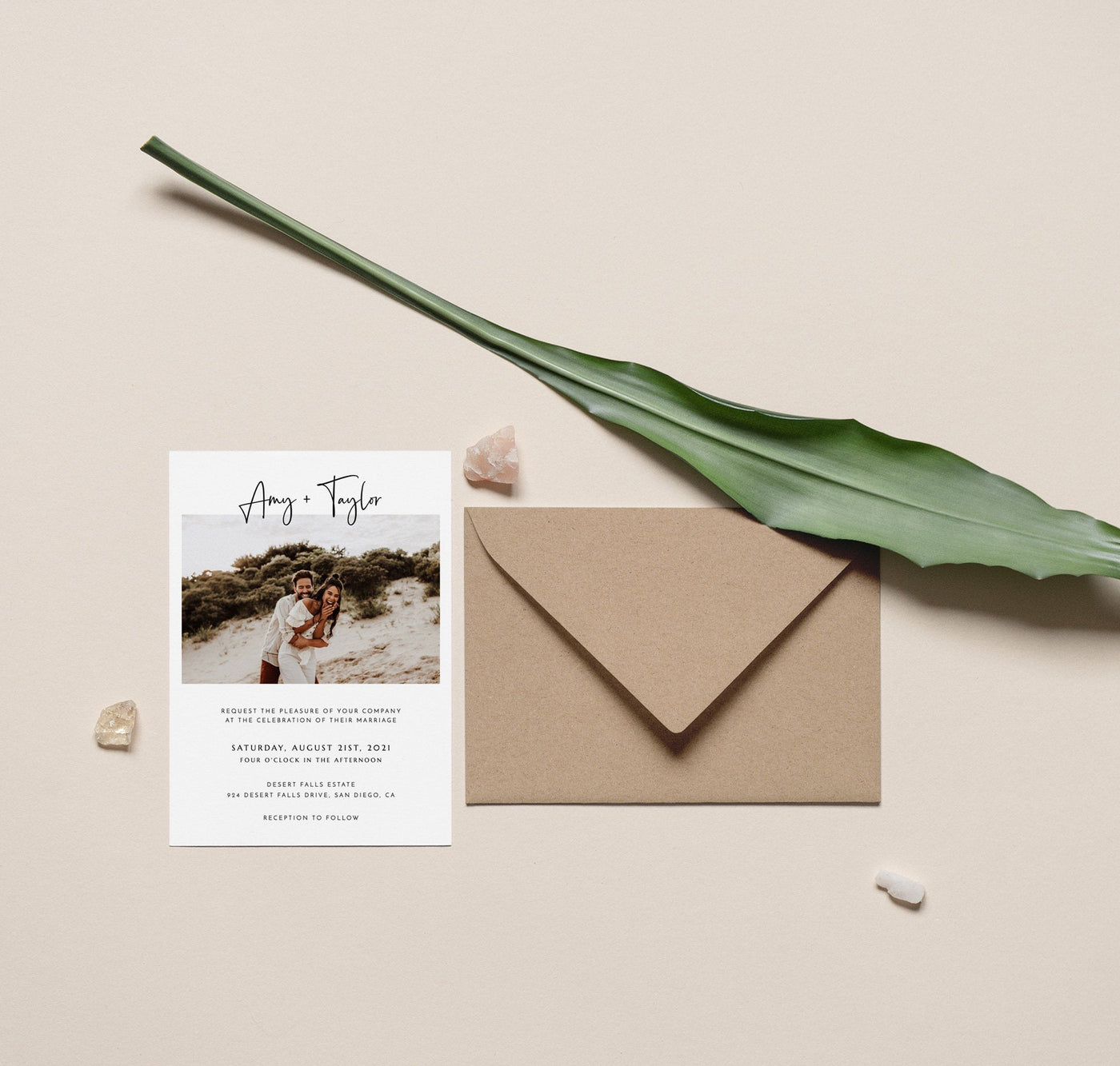
Let's be real: nobody at your wedding will remember whether your invitation said "request the honour of your presence" or "would love for you to join us." But you will absolutely lose three nights of sleep over it anyway — staring at a blank Templett file, wondering if you've offended your stepdad, your grandmother, and the etiquette gods all at once.
Here's the truth most wedding blogs won't tell you: there is no single "correct" wedding invitation wording. There's traditional wording, there's modern wording, and there's whatever actually fits your family and your day. The rules exist to make hard situations easier — not to trap you. And if your situation is messy (divorced parents, a parent who's passed, a blended family, a couple paying for the whole thing themselves), you are not the first person to need exact words for it. You're in good company.
This guide gives you the anatomy of an invitation, the difference between formal and casual wording, and copy-paste templates for nearly every situation you'll hit — including the awkward ones. Bookmark it. You'll come back when you sit down to actually fill in your editable invitation templates or proof a set of printed invitations before they ship. (And if you want to see how it all fits together with signs and decor, the full wedding collection has the matching pieces.)

The Anatomy of a Wedding Invitation (Line by Line)
Almost every wedding invitation — formal or casual, printed or digital — is built from the same eight building blocks, stacked top to bottom. Once you can name the parts, the wording stops feeling like a riddle. Here's each line, what it's for, and what trips people up.
1. The Host Line
This is the very top line, and it names whoever is hosting (traditionally: paying). It's the part that causes 90% of the family stress, because "who hosts" used to mean "whose name goes first" — which means it quietly signals money, status, and which side of the family is in charge. We'll untangle every version of this below, because it's where divorce, remarriage, and blended families all collide.
If you and your partner are paying for your own wedding, the host line can simply be you two — or you can skip a formal host line entirely. More on that later.
2. The Request Line
This is the invitation itself — the "please come" line. The wording here is the single biggest tell of how formal your wedding is:
- Most formal (religious venue): "request the honour of your presence" — note the British spelling of "honour," which traditionally signals a ceremony in a house of worship.
- Formal (non-religious venue): "request the pleasure of your company"
- Semi-formal: "invite you to celebrate with them" or "invite you to share in their joy"
- Casual: "want you there," "would love for you to join them," or "are getting married — and you're invited!"
3. The Names of the Couple
Traditionally the bride's name comes first in a different-sex couple, and full names (often with middle names) are used in formal wording. For same-sex couples, you can go alphabetical, by who-asked-whom, or whatever flows best — there is no rule and no wrong order. In casual invitations, first names alone are perfectly fine.

4. The Date and Time
Formal invitations spell everything out — no numerals. "Saturday, the fourteenth of June, two thousand twenty-six, at half after four o'clock." Casual invitations just write "Saturday, June 14, 2026, at 4:30 in the afternoon." Spell out "in the afternoon" / "in the evening" rather than using a.m./p.m. on formal suites.
5. The Venue / Location
Name the venue, then the city and state on the next line. Formal wording omits the street address from the main invitation (it goes on the details card instead). Casual invitations can include the full address right there — whatever's clearest for your guests.
6. The Reception Line
This tells guests what happens after the ceremony. If the reception is at the same place: "Reception to follow." If it's elsewhere: "Reception to follow at [venue]" — or push the details to a separate card. This one line quietly answers "do I need to drive somewhere after?"
7. Dress Code (Optional)
You don't need a dress code line, but if you have a specific vibe (black tie, cocktail, garden-party casual), put it in the lower corner or on the details card. Guests genuinely appreciate it — nobody wants to be the only one in a suit at a beach wedding.
8. The RSVP / Reply Instruction
Either a "kindly reply by [date]" line on the main invitation, or — more common — a separate RSVP card or a wedding-website URL. We'll cover RSVP wording in its own section because there's a right way to do the date.
Formal vs. Modern vs. Casual: The Same Wedding, Three Ways
To see how the building blocks change with tone, here's the exact same wedding written three ways. Copy whichever voice sounds like you, then swap in your details. All three work beautifully whether you're using an editable digital template you print yourself or ordering printed and shipped invitations.
Formal (Traditional)
Mr. and Mrs. James Whitfield request the honour of your presence at the marriage of their daughter Emma Rose to Daniel Thomas Reed Saturday, the fourteenth of June two thousand twenty-six at half after four o'clock The Grand Hall Charleston, South Carolina Reception to follow
Modern / Semi-Formal
Together with their families Emma Whitfield & Daniel Reed invite you to celebrate their wedding Saturday, June 14, 2026 at 4:30 in the afternoon The Grand Hall Charleston, South Carolina Dinner, drinks, and dancing to follow
Casual / Playful
Emma & Daniel are getting married! And they'd love for you to be there. Saturday, June 14, 2026 · 4:30 pm The Grand Hall, Charleston, SC Stick around after for good food, strong drinks, and questionable dancing.
See how the bones are identical? Host line, request, names, date, place, reception. Only the language and formatting move. Once you've picked your tone, keep it consistent across the whole suite — the RSVP card and details card should sound like the same wedding.

Host Line Templates for Every Family Situation
This is the section you came for. The host line is where family structure shows up, and there's a clean, correct way to word every situation — including the hard ones. Take a breath: none of these are wrong, and your guests will not be doing forensic analysis. Pick the one that fits and move on.
Both Sets of Parents Hosting
The most common modern setup. List the partner's-family names in the same order as the couple's names below.
Mr. and Mrs. James Whitfield and Mr. and Mrs. Robert Reed request the pleasure of your company at the marriage of their children Emma and Daniel
One Set of Parents Hosting
If only one family is hosting, name them — and include the other partner's full name so guests know who's marrying in.
Mr. and Mrs. James Whitfield request the honour of your presence at the marriage of their daughter Emma Rose to Daniel Thomas Reed
The Couple Hosting Themselves
Paying for your own wedding? You don't owe anyone a parental host line. Two clean options:
Option A — warm and inclusive: Together with their families Emma Whitfield and Daniel Reed invite you to celebrate their marriage Option B — couple-forward: Emma Whitfield and Daniel Reed request the pleasure of your company at their wedding
Divorced Parents (Not Remarried)
List each parent on their own line, mother's name first, with no "and" connecting them (the missing "and" is the quiet signal that they're no longer a couple).
Ms. Catherine Whitfield Mr. James Whitfield request the honour of your presence at the marriage of their daughter Emma Rose
Divorced and Remarried Parents
If a parent has remarried and you want to include stepparents, use the married-couple format for each household. The biological parent's name comes first within their household line.
Ms. Catherine Whitfield and Mr. David Lowe and Mr. James Whitfield and Mrs. Sarah Whitfield request the pleasure of your company at the marriage of Emma Rose Whitfield
If a stepparent essentially raised you and you want to honor that, it's completely fine to list them. If you'd rather keep it to biological parents, that's fine too. This is your call, not the etiquette police's.
A Deceased Parent
This one matters, and there's a gentle, traditional way to honor a parent who has passed. You don't include a deceased person in the host line (hosts are the living people inviting you), but you can name them lovingly in the request line.
Mrs. Catherine Whitfield requests the honour of your presence at the marriage of her daughter Emma Rose daughter of Mr. James Whitfield to Daniel Thomas Reed
Or, more explicitly memorial:
Emma Rose Whitfield daughter of Catherine Whitfield and the late James Whitfield and Daniel Thomas Reed invite you to share in their joy
There's no wrong amount of acknowledgment here. Some couples add a small line on the ceremony program instead ("In loving memory of...") to keep the invitation itself light. Do whatever helps your heart.
Blended Families with Multiple Households
When there are four parents across two or three households, the invitation can start to look like a phone book. Two fixes: (1) use the "Together with their families" opener and skip naming everyone, or (2) list households on separate lines without trying to cram them onto one. Clarity beats completeness.
Together with their families Emma Rose Whitfield and Daniel Thomas Reed invite you to celebrate their wedding
Military Titles and Ranks
For active-duty or veteran couples and parents, rank replaces the civilian title and is spelled out. The branch of service goes on the line below the name.
- Junior officers (rank below Captain in the Army, or Lieutenant Commander in the Navy): name on the first line, rank and branch below — "Daniel Thomas Reed / First Lieutenant, United States Army"
- Higher ranks: title precedes the name — "Captain Daniel Thomas Reed / United States Navy"
- Retired officers: "Colonel James Whitfield, United States Air Force, Retired"
Captain and Mrs. James Whitfield request the honour of your presence at the marriage of their daughter Emma Rose to First Lieutenant Daniel Thomas Reed United States Army

How to Word the RSVP Card
The RSVP (reply) card is small but it does a lot of work, and a vague one creates chaos — half your guests won't reply and the other half won't tell you their meal choice. Keep it specific. Whether you're filling in a digital template or proofing printed reply cards, your RSVP card needs three things: a reply-by date, a yes/no mechanism, and (if you're serving a plated meal) a meal selection.
Set the Reply-By Date Correctly
Your reply deadline should land 3 to 4 weeks before the wedding — caterers and venues usually need final headcounts 2 weeks out, and you'll need buffer time to chase the stragglers (there are always stragglers). Count backward from your date and pick a clean number.
Classic RSVP Card Templates
Formal: The favour of a reply is requested by the first of May M_______________________ ___ accepts with pleasure ___ declines with regret
Modern: Kindly reply by May 1, 2026 Name(s): _______________ ___ Joyfully accepts ___ Regretfully declines
Casual / fun: Let us know by May 1! ___ Wouldn't miss it ___ Will be there in spirit (sad face) Guest name(s): _______________
(That "M_______" line on the formal card is for guests to write their title — Mr., Mrs., Ms. — then their name. It confuses everyone the first time they see it, so don't worry, it's not just you.)
Adding a Meal Choice
Please select your entrée: ___ Herb-roasted chicken ___ Seared salmon ___ Wild mushroom risotto (v) Dietary restrictions: _______________
If You're Using a Wedding Website Instead
Online RSVPs are increasingly normal and save you a stack of return-postage stamps. Just put one clean line on your details card:
Kindly reply by May 1, 2026 at www.emmaanddaniel.com or scan the QR code below
How to Word the Details / Information Card
The details card is where all the logistics live so your main invitation can stay clean and pretty. It's also where guests look for the stuff they actually need: where to sleep, where to park, and what to wear. Bundle it all here rather than crowding the invitation.
Common details-card sections, with sample wording:
- Accommodations: "We've reserved a block of rooms at The Riverside Hotel. Mention 'Whitfield-Reed Wedding' by May 1 for the group rate."
- Getting there: "The nearest airport is Charleston International (CHS), 20 minutes from the venue. Parking is available on site."
- Dress code: "Cocktail attire. The ceremony is outdoors on grass — plan your shoes accordingly."
- Wedding website: "Full schedule, registry, and travel tips: www.emmaanddaniel.com"
- Shuttle / transportation: "A shuttle will run from The Riverside Hotel to the venue starting at 3:30 pm."
That dress-code-meets-terrain note ("outdoors on grass") is the kind of small, human detail your guests will quietly thank you for. It's the same instinct behind a good wedding welcome sign at the venue — anticipate the question before it's asked. (Our post on welcome sign ideas for every style has plenty of inspiration once you get there.)

How to Word "Adults Only" Without Sounding Cold
You are allowed to have an adults-only wedding. Truly. It's one of the most common — and most agonized-over — wording decisions, because nobody wants to seem like they hate children. The trick is to never write "adults only" on the invitation itself. You communicate it through the addressing and a soft line on the details card.
The Three-Layer Approach
- Address envelopes precisely. Write only the names of the people invited. "Mr. and Mrs. James Whitfield" (no "and family," no children's names) signals the kids aren't included.
- Add a gentle line on the details card or website, not the main invitation.
- Tell key family members directly, by phone or text, so close relatives with kids aren't blindsided.
Soft Adults-Only Wording Templates
- "We love your little ones, but this will be an adults-only celebration. We hope this gives you a night off to relax with us."
- "To allow all guests to relax and enjoy the evening, we have chosen for our wedding to be an adults-only event."
- "While we adore your children, we kindly request this be an adults-only occasion. Thank you for understanding."
- "Adults-only reception. Let us treat you to a night out!"
If you're inviting some kids (like the wedding party's), the precise-addressing rule does the heavy lifting — you simply name the children who are invited on their family's envelope and leave them off the others.
How to Word Plus-Ones (Without Inviting the Whole Neighborhood)
Plus-ones are a budget line item disguised as an etiquette question. Every extra "and guest" is another plate, another chair, another centerpiece. Here's how to control it through wording — again, mostly on the envelope, not the invitation.
Granting a Plus-One
- Inner envelope: "Mr. Daniel Reed and Guest"
- If you know the partner's name (always nicer): address it directly to "Mr. Daniel Reed and Ms. Olivia Chen"
- On the RSVP card: "We have reserved ___ seats in your honor" — then write the number. It tells guests exactly how many people are invited.
Not Granting a Plus-One
Address the envelope to that guest alone, and use the "we have reserved ___ seats in your honor: 1" line. No plus-one wording means no plus-one — you don't have to explain it. If someone asks, "We're keeping it small and only able to host the people closest to us" is a complete, kind answer.
The "___ seats reserved in your honor" trick is genuinely the unsung hero of wedding RSVP wording. It quietly answers the plus-one question, the kids question, and the headcount question all at once.
A Word on the Save the Date (It Sets the Tone)
Your save the date goes out 6 to 8 months before the wedding — long before the formal invitation, often right after the engagement — and its job is just two facts: the date and the city, so guests can book travel. The wording is short and casual by design:
Save the Date Emma & Daniel are tying the knot! June 14, 2026 · Charleston, SC Formal invitation to follow
Always include "Formal invitation to follow" so guests know more details are coming and don't think the save the date is the invitation. If you're working on yours now, browse our save the date templates and printed cards — and for the bigger picture of timing, our complete wedding sign checklist walks through what you'll need at the venue once the RSVPs are in.

Proofreading Your Invitation Before It Prints (Don't Skip This)
Here's a small horror story: a couple once mailed 200 invitations with the wrong year. Another sent guests to the reception venue an hour early because of a single transposed time. Once it's printed, it's printed — so proofreading is the highest-leverage 20 minutes of this entire process. Slow down here.
The Pre-Print Checklist
- Names: Every name spelled correctly, including middle names, stepparents, and your in-laws-to-be. Misspelling a parent's name is the one mistake nobody forgets.
- Date AND day: Confirm that "Saturday, June 14, 2026" is actually a Saturday. Pull up a calendar. Mismatched day-and-date is the most common error there is.
- Time: Right number, right "in the afternoon/evening." Double-check ceremony vs. reception start times.
- Venue name and city: Spelled correctly and the correct location (especially if your venue has two locations).
- RSVP date: 3–4 weeks before the wedding, and it's a real date that exists.
- Website URL: Type it into a browser and confirm it actually loads.
- Consistency: Same formality and same formatting (numerals vs. spelled-out) across the invitation, RSVP, and details cards.
Read It Out Loud, Backward, and With Fresh Eyes
Three tricks that catch what your brain auto-corrects:
- Read it out loud. Your ear catches what your eye skims.
- Read it backward, word by word. Sounds silly, works great for spelling — it stops your brain from reading the sentence it expects to see.
- Get two fresh sets of eyes. Ideally one person who's good with names and one who's good with numbers. Your partner doesn't count — you've both stared at it too long.
This is also where the format you chose pays off. With an editable digital template, you can fix a typo and reprint a single page yourself in minutes. With printed and shipped invitations, you'll approve a digital proof before anything goes to the printer — so the catch happens on screen, not in 200 envelopes. If you're still deciding between the two, our honest breakdown of editable templates vs. printed and shipped lays out exactly who each one is for — you can browse all our digital downloads on one side and everything printed and shipped on the other.
Common Wedding Invitation Wording Questions
Whose name goes first on a wedding invitation?
Traditionally the bride's name comes first in a different-sex couple. For same-sex couples, go alphabetical or by personal preference. In the host line, the hosting family's names lead. None of this is law — it's convention, and conventions bend.
Do you put the year on a wedding invitation?
Yes, always include the year. On formal invitations it's spelled out ("two thousand twenty-six"); on casual ones, the numeral is fine. The year prevents any confusion, especially for save the dates booked far in advance.
"Honour" or "honor"? "Favour" or "favor"?
The British spelling ("honour," "favour") is the traditional formal choice and historically signals a ceremony in a house of worship. The American spelling is perfectly correct for everything else. Pick one and stay consistent across the suite.
How do you word it when the couple is hosting but parents helped pay?
The warm, diplomatic answer is "Together with their families" — it honors everyone's contribution without ranking who paid what. It's become an increasingly common host line for exactly this reason.
What if our families are complicated and none of these fit perfectly?
Then "Together with their families" is your friend. It's gracious, inclusive, and sidesteps every awkward naming question in one line. Truly, when in doubt, that's the phrase. You are not behind, you are not doing it wrong, and your family situation is more common than you think.
Coordinating Your Invitations With the Rest of the Day
Once the wording is locked, your invitation suite becomes the style reference for everything else — your save the dates (already mailed), your ceremony programs, your welcome sign, your table numbers, and your thank-you cards afterward. Matching fonts and colors across all of it makes the whole day feel pulled-together without any extra effort on your part.
For the signage side of things, our guide to wedding welcome sign wording mirrors a lot of the formal-vs-casual logic here, and what size your welcome sign should be answers the question right before you order. If you're deep in planning mode, the complete checklist of every sign you need makes sure nothing slips through. And if there's a bridal shower in the mix, the bridal shower planning timeline keeps that piece on track too — and you'll want a stack of bridal shower invitations and some party games to go with it.
You've Got This (Pick a Template and Start)
Wedding invitation wording feels enormous until you realize it's just eight lines and a handful of family-specific swaps. Pick the tone that sounds like you, drop in the host-line template that fits your family, set a sensible RSVP date, proofread like your sanity depends on it (it does a little), and you're done. Nobody will remember the napkins — but a clear, warm invitation that gets everyone to the right place at the right time? That's the part that actually matters.
When you're ready to build the real thing, you can edit it yourself with our customizable invitation templates in Templett and print at home, or let us personalize and ship a polished set with our printed wedding invitations. Browse the full wedding collection to match your invitations to your signs and save the dates — and go enjoy this. You're getting married.